


Let’s talk albariño
 Stephen Wong MW in Wine News
 Become a member to view this article
The Real Review is editorially independent. We don’t sell wine. We are free of influence from vested interests such as wine producers and sellers, and proprietors with conflicts. We tell you what we think about reviewed wines, served straight up. Our articles cover topics our writers choose because of genuine interest.
We rely on our members to publish The Real Review. Membership provides access to thousands of articles, a growing database of more than 160,000 wine tasting notes, exclusive member discounts and more.
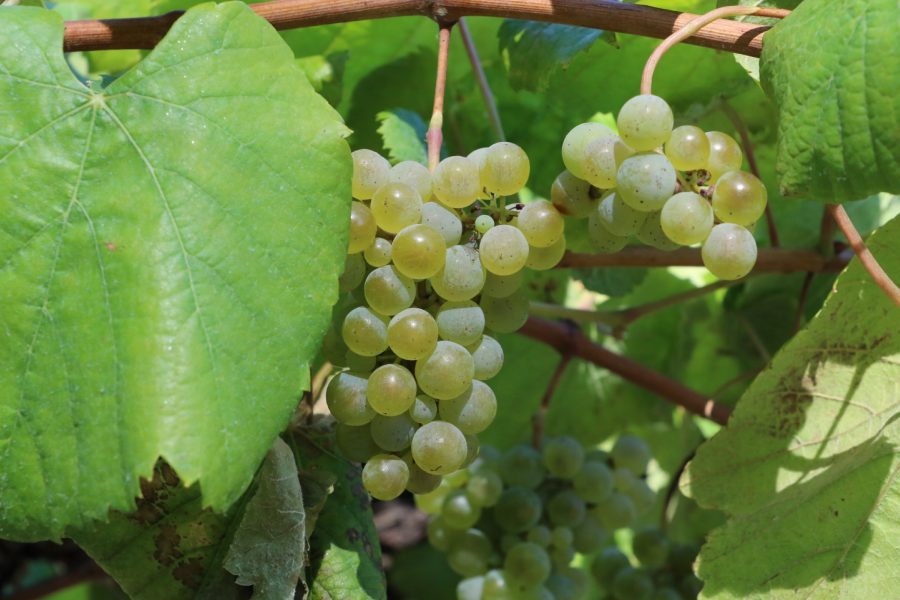
Albariño grapes on the vine. Wikimedia Commons
.jpg)
Twenty albariño fanatics, comprising writers, winemakers, growers and marketing specialists converged at the Smith & Sheth Oenothèque in Havelock North on August 4 for the Two Terraces Albariño Workshop.
The goal was to taste and discuss the variety’s place in Aotearoa. The idea was put together by Ian Quinn from Two Terraces Vineyard, who grows the grape and supplies it to several winemakers in the region, including most of those present.
The idea was put together by Ian Quinn from Two Terraces Vineyard, who grows the grape and supplies it to several winemakers in the region, including most of those present.The group was kindly hosted by Natalie Grace, brand and marketing manager of AONZ, who own the Smith & Sheth brand. I was present to lead the tasting and moderate the discussion and had already done a sneak peek of new albariño components out of tanks and barrels with winemaker Warren Gibson the afternoon prior (you can watch snippets of the trip in this video).
There were lofty goals for this workshop. The group aimed to understand the global landscape of the finest quality expressions of albariño (naturally from Rías Baixas), including carefully harnessed oak ageing, long lees or bottle ageing, the use of malolactic conversion, skin-contact and even partial skin-fermentation, and the use of lower flavour-impact ageing vessels like clay, concrete and stainless steel. Ripeness of fruit expression or fresher, taut styles were compared as well as wines with up to eight years of age.
These were tasted blind in flights of four (see the list below) to demonstrate how these can subtly impact the wine. Rather than taste young albariño from New Zealand, we elected to match the age and vintage of the Rías Baixas wines by choosing 2021. Amy and Olly Hopkinson-Styles of Halcyon Days did heavy-duty sourcing in the UK and Spain for many of these bottles and lugged them back to Aotearoa for the class.
Ian and Linda Quinn, from a Two Terraces grower perspective, also wanted to spark local collaboration and accelerate the development of multiple concurrent high quality expressions rather than converging into a commoditised style, which in turn encourages a more broadly sustainable ecosystem of artisan and small-scale production rather than falling into the same volume- and price-driven trap which dominates the production landscape.
- Zarate Balado 2022 – Meaño, Salnes
- Zarate Tras da Viña 2021 – Meaño, Salnes
- Rodrigo Mendez Salvora 2020 – Meaño, Salnes
- Rodrigo Mendez Salvora 2021 – Meaño, Salnes
- Forjas de Salnes Leirana Finca Genoveva 2022 – Meaño, Salnes
- Fillaboa Seleccíon Finca Monte Alto 2021 – Monte Alto, Condado de Tea
- Nanclares y Prieto La Tinaja de Aranzazu 2021 – Cambados & Ribadumia, Salnes
- Pazo de Barrantes Comtes 2017 Barrantes – Ribadumias, Salnes
- Esk Valley Albariño 2021 – Mangatahi, Hawke’s Bay
- Neudorf Rosie’s Block Moutere Albariño 2021 – Moutere, Nelson
- Villa Maria Reserve Hawke’s Bay Albariño 2021 – Mangatahi, Hawke’s Bay
- Smith & Sheth CRU Heretaunga Albariño 2021 – Bridge Pā, Hawke’s Bay
Now, it is worth noting that there was an earlier deep-dive workshop at Neudorf in Nelson held eight years ago on 21 September 2017. In hindsight, given the deep interest which the Finns and Todd Stevens had for global benchmark albariño, it is unsurprising that Neudorf Rosie’s Block Moutere Albariño is the first albariño in the country to achieve The Real Review Classification status.
Back in 2017, there was certainly a lot less albariño planted in the country (the first New Zealand albariño was released by Cooper’s Creek in 2011) so the tasting focused on exploring different styles from Rías Baixas. The attendees skewed towards commentators and writers (including myself and Bob Campbell MW) rather than growers and makers so the conversation had a less technical bias. The variety was also less well understood at the time, and not just in Aotearoa.
Although ‘modern’ albariño started in the 1980s in Rías Baixas, the current understanding of subregions is more recent – after all, the fifth and youngest subregion of Ribeiro do Ulla was only granted recognition in 2000). Single-vineyard, carefully aged and complex super-premium albariño is really a creation of the 2010s. I recall much of the discussion at the 2017 event centred around the influence of oak vs freshness, something which seemed to be an either/or issue at the time and largely resolved by the time of the 2025 workshop.
In fact, across the board, there was very little obvious winemaking impact in the set of wines tasted in 2025; oak was nearly imperceptible in most of the wines even when it was present. The warmer vintages and subregions (like Condado do Tea) clearly had a riper fruit spectrum but acidities and palate shape were still within bounds and even the older wines were still fresh and few tasters expected them to be as old as they were.
Site expression was paramount and even though winemaking did of course have an influence (such as the winemakers who used little to no sulfur), it was not as extreme as expected. This felt like a very different workshop than 2017’s and we felt like we were seeing something coalesce in the room which was important.
Site expression was paramount and even though winemaking did of course have an influence, it was not as extreme as expected.The other reason this felt like a watershed moment was the very different composition of the audience. Winegrowers and winemakers formed the overwhelming majority of the room including several who had worked (or still work!) in Galicia previously; Alistair from Grava Wines, Natalie Christensen of Yealands, Amy and Olly Hopkinson-Styles. Together with Jannine Rickards of Huntress, the aforementioned winemakers had just bottled their collaborative albariño Rias that weekend in the Wairarapa.
Additionally, we also had the expert contributions of winemakers Gordon Russell (who made the early albariños at Esk Valley), Warren Gibson, Daniel Brennan of Decibel, Casey Motley from Three Fates, Lauren Swift of Swift Wines, Rod Easthope from Easthope Family Winegrowers, Amy Farnsworth of Amoise and Hayden Penny of Organised Chaos. Viticulturists Dan Brewster (AONZ), Greg Allinson (Craggy Range) and Claire Pinker (Church Road) brought the grower perspective to the room.
As the workshop wrapped up and everyone returned to their jobs, there was a palpable sense of anticipation for how this initiative by the Quinns to encourage collaboration and emergent ideas could be just the catalyst needed to catapult New Zealand’s albariño wines to the next level.